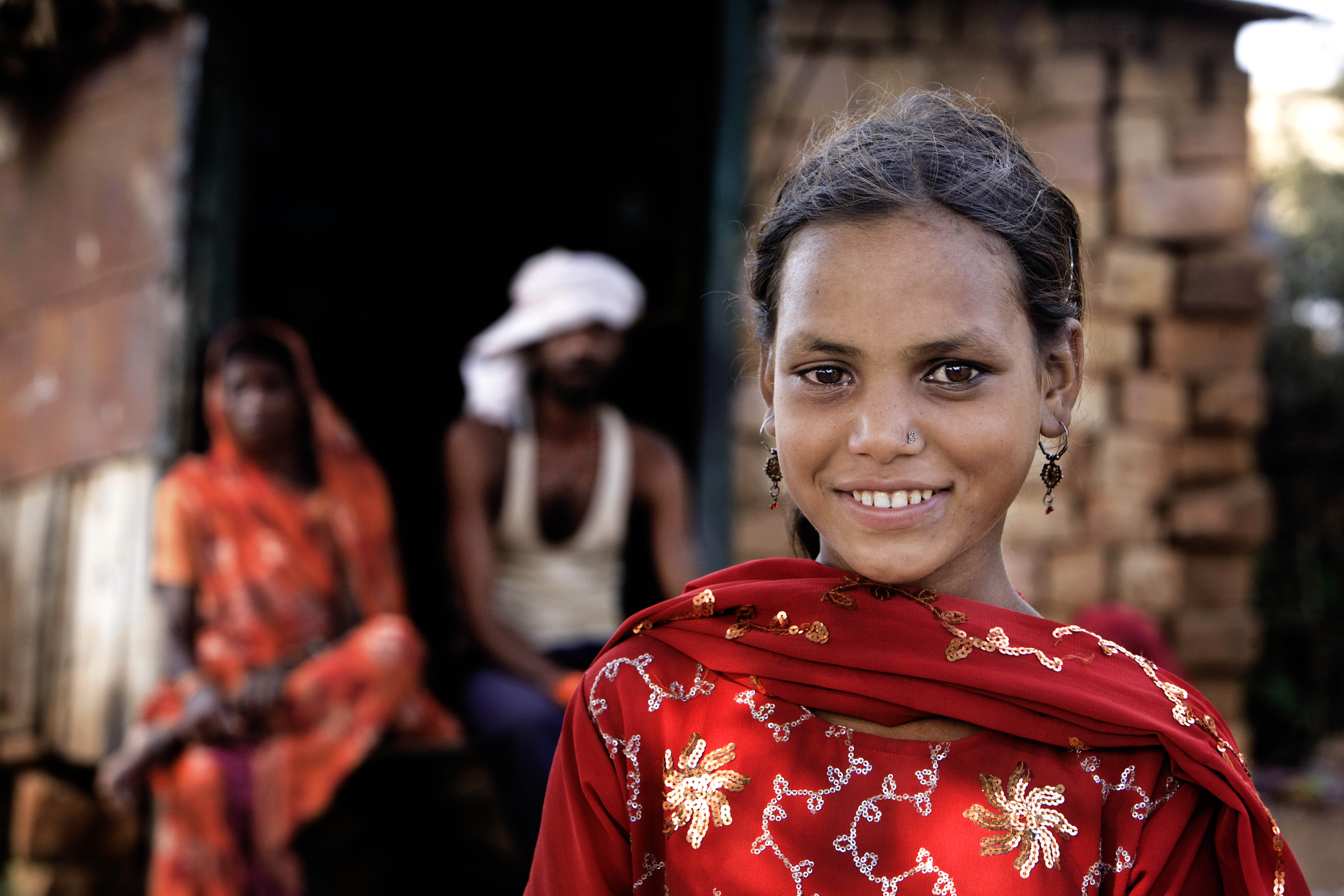
Child marriage is any formal marriage or informal union where one or both of the parties are under 18 years of age. According to Girls Not Brides, every year 12 million underage girls get married. Globally, it is estimated that there are 640 million women alive today who were married before the age of 18—that’s 10% of the world’s population. Globally, the rates of child marriage are slowly declining but progress isn't happening fast enough. Child marriage happens everywhere but is most prevalent in south Asia (26% of girls married by 18; 6% married by 15), sub-Saharan Africa (31%; 9%), and Latin America and the Caribbean (21%; 4%).
Terminology‘Child marriage’, ‘early marriage’, ‘arranged marriage’, and ‘forced marriage’ are often used interchangeably. However, each describes a particular phenomenon, which in practice, often overlap. Forced marriage is where one or both people do not consent to the marriage or consent to stay in the marriage, and pressure or abuse is used to coerce one or both parties. This is different to an arranged marriage, where both people are at least 18 years old and have consented to the union. Child marriages are a form of forced marriage because a child cannot provide full, free, and informed consent. Early marriage is often used synonymously with child marriage. At RTE we prefer the term ‘child marriage’ because ‘early’ is a relative term, whereas ‘child’ under international law refers to anyone who has not reached the age of majority, i.e., the age at which someone is considered an adult. For further information, see paras 20-24 of CEDAW and CRC Joint General Recommendation 31 on harmful practices.
|
Child marriage is a discriminatory practice rooted in the notion that girls and women are inferior to men and should conform to gender stereotypes that value women as mothers, carers, the property of men, sexual objects, vulnerable and in need of protection, and not as rights-holders. Myriad factors also contribute to the perpetuation of child marriage, including: gender inequality, poverty, gaps in and non-implementation of laws, lack of education, peer pressure, and conflict and emergencies. See CARE’s
page on the causes of child marriage for further information.
Child marriage violates multiple human rights, including the right to education, making it a particularly egregious practice. Children who get married are more likely to drop out of school and children who are not in school are more likely to get married. Statistics from the World Bank and International Center for Research on Women reveal that 10-30% of parents, depending on country, reported that their child dropped out of secondary school due to child marriage and/or pregnancy. Their research also indicates that for every year a girl marries before the age of 18, the likelihood she completes secondary education decreases by 0.22 years on average. In Latin America and Asia, girls who marry before the age of 12 have a reduced likelihood of 21% of completing their secondary education.
Although permissible under international law, marriages that occur after the age of 18 may also affect a girl’s education, particularly her ability to access higher education or other forms of tertiary education.
Linked to child marriage is early and unintended pregnancy. Girls Not Brides report that 90% of adolescent births in low and lower-middle income countries are to married girls. Pregnancy and motherhood often has profound impacts on girls’ education. Pregnant girls are often banned from attending school and sitting exams, and mothers often lack access to bridging programmes which allow girls to catch-up on their missed education in order to reenter mainstream education. Further, lack of free early childhood care and widely held beliefs that child rearing is the primary responsibility of the mother, means that women and girls often do not reenter education.
Pregnancy and motherhood can also occur independently from child marriage, as a result of rape, which is particularly common during conflict and other emergencies (see the case of Sierra Leone which saw an increase in teenage pregnancy during the ebola crisis due to the closure of schools). Teenage pregnancy and motherhood is also a product of a lack of information about sexual and reproductive health and a lack of access to contraception (birth control). See for example, our photo essay on the right to education of pregnant girls in Kenya.
So what does international law say about child marriage and what obligations do states have to ensure the right to education of married and/or pregnant girls?
The Committee on the Rights of the Child and the Committee on the Elimination of All Forms of Discrimination against Women have stated, in a Joint Recommendation, that the minimum age for marriage should be 18 for both men and women. However, the committees take the view that a balance must be struck between recognising that child marriage is a harmful, discriminatory practice and respecting that in exceptional cases some children may be mature and capable enough to make informed decisions for his/herself regarding getting married, provided the child in question is at least 16 years old and such decisions are assessed by a judge ‘based on legitimate exceptional grounds defined by law and on the evidence of maturity, without deference to culture and tradition’ (para. 20).
This limited exception, however, does not in any way dilute states’ obligations to eliminate child marriage and early or unintended pregnancy, and to protect the human rights of child brides and mothers, including the right to education.
In order to prevent child marriage states must establish and enforce a minimum age of marriage of 18. Often, minimum legal ages for marriage are set, but the law is inconsistent (see Tanzania, for example), customary law, such as Shari’a or tribal law applies, or the law allows girls to be married in certain situations, for example, if she is pregnant or has parental permission. Under international law, exceptions such as these are prohibited.
In Africa, regional human rights law is strong and mandates that states enact legislation that sets the minimum age of marriage at 18 without exception (Article 6 (b), Protocol to the African Charter on Human and Peoples’ Rights on the Rights of Women in Africa [2003]; Article 21 (2), African Charter on the Rights and Welfare of the Child [1990]. For further information on the interpretation of these articles, see the Joint General Comment of the African Commission on Human and Peoples’ Rights and the African Committee of Experts on the Rights and Welfare of the Child on ending child marriage).
The map below illustrates that very few states have set the minimum age of marriage at 18. This is particularly true of the Americas, sub-Saharan Africa, and South East Asia—all regions with high child marriage prevalence rates. It should also be pointed out that child marriage is permissible by law in a number of ‘global north’ countries, notably the US.

Under international law, states are not allowed to refuse access to school by expelling girls on the basis of marriage, pregnancy, or having given birth as this would constitute discrimination. This includes a prohibition of mandatory pregnancy testing, which has been documented in various African states, including: Tanzania, Ghana, Kenya, Nigeria, Sierra Leone, Uganda, and Zimbabwe.
Further, in order to rectify the negative impacts of child marriage and early pregnancy on the right to education, for example, if a girl misses any of her primary education, states must provide fundamental education, that is education that replaces missed primary education for girls who become married or pregnant at primary school age (Article 13 (d), International Covenant on Economic, Social and Cultural Rights). However, most child marriages and early pregnancies occur during secondary education. The Convention on the Elimination of All Forms of Discrimination against Women (1979, CEDAW) adapts the fundamental education provision to include obligations to make efforts to keep girls in school and to organise ‘programmes for girls and women who have left school prematurely’ (Article 10 (f)). Programmes that allow girls to re-enter education are known as ‘re-entry programmes’. Successful examples of reentry programmes include Zambia and Uganda.
Given the prevalence of child marriage and pregnancy in African countries, African human rights law also makes provision for fundamental education and reentry programmes but protections are inconsistent.
The African Youth Charter (2006) requires states to: ‘Ensure, where applicable, that girls and young women who become pregnant or married before completing their education shall have the opportunity to continue their education’ (Article 13 (4) (h)).
Article 12 (2) (c) of the Protocol to the African Charter on Human and Peoples’ Rights on the Rights of Women in Africa is less specific and urges states to ‘promote the enrolment and retention of girls in schools and other training institutions and the organisation of programmes for women who leave school prematurely’.
Article 11 (6), African Charter on the Rights and Welfare of the Child, requires states to take ‘all appropriate measures to ensure that children who become pregnant before completing their education shall have an opportunity to continue with their education on the basis of their individual ability.’ Although this provision would seem to provide for re-entry programmes, the caveat that such opportunity is based on ‘individual ability’ falls short of international standards.
International law also seeks to empower girls to make decisions for themselves regarding unintended pregnancy and requires that sex, reproductive health, and responsible parenthood education is given to both boys and girls. See, for example, Article 10 (h), Convention on the Elimination of All Forms of Discrimination against Women and Article 13 (4) (n), African Youth Charter. Below is a video explaining the importance of comprehensive sexuality education.
[[{"fid":"1714","view_mode":"default","fields":{"format":"default"},"type":"media","field_deltas":{"2":{"format":"default"}},"link_text":"Being a Young Person: Comprehensive Sexuality Education","attributes":{"class":"media-element file-default","data-delta":"2"}}]]
Lastly, international law requires states to dismantle the social, economic, cultural, and political conditions that facilitate the pervasive nature of this practice. A holistic approach is required to eliminate child marriage and pregnancy because its causes are varied and deeply entrenched. However, evidence suggests that any approach must include efforts to ensure girls enjoy and can exercise their right to education. Girls Not Brides states that girls with a secondary education are six times less likely to marry than a girl with little or no education.
For more information on preventing child marriage and early and unintended pregnancy through education, see Unesco’s Early and unintended pregnancy: Recommendations for the education sector (2017).