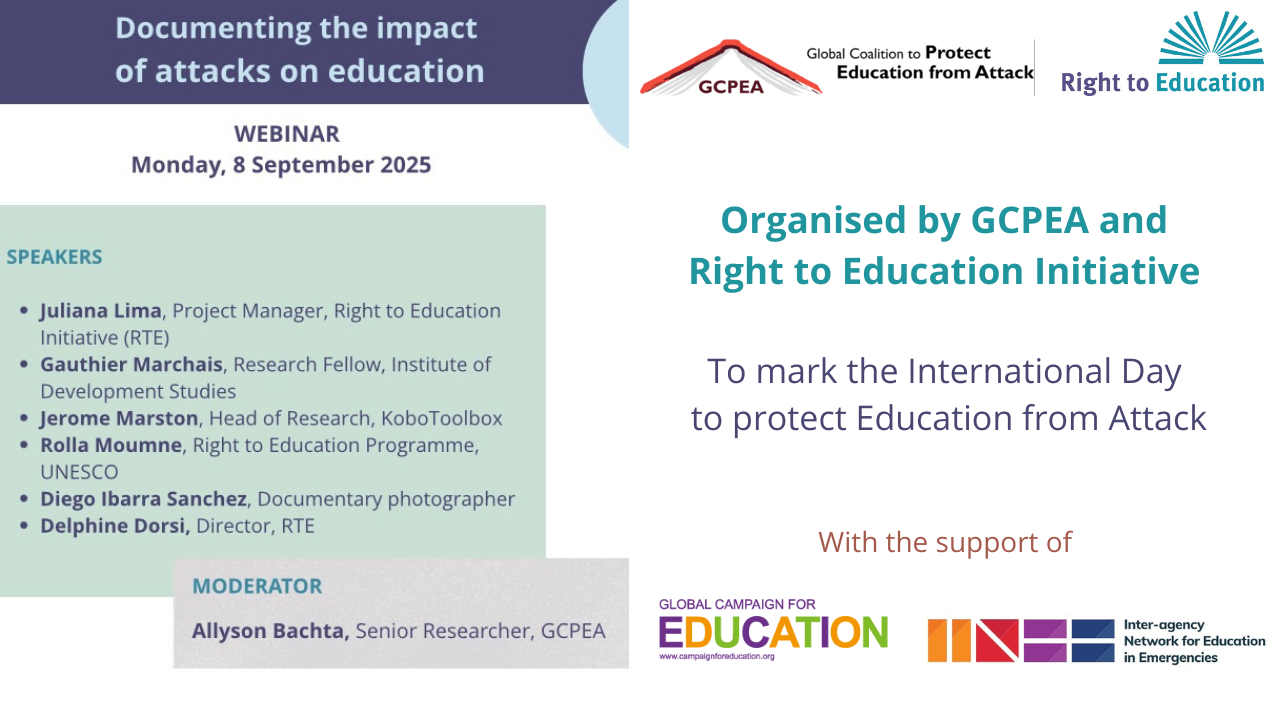
On 8 September 2025, on the eve of the International Day to Protect Education from Attack, the Right to Education Initiative (RTE), together with the Global Coalition to Protect Education from Attack (GCPEA), and the support of the Inter-agency Network for Education in Emergencies (INEE), and the Global Campaign for Education (GCE), hosted a webinar on ‘Documenting the Impact of Attacks on Education.’
The online event brought together 120+ participants including representatives of international organisations, civil society organisations, and academics, many of whom are directly engaged in fieldwork in conflict-affected contexts. The webinar was conducted in English with simultaneous interpretation into French, Spanish, and Arabic, reflecting the global urgency of the issue and the need to make information accessible across the world.
Framing the challenge
Moderator Allyson Bachta, Senior Researcher at GCPEA, opened the discussion by underlining worrying trends: ‘Attacks on education are rising at an alarming pace, undermining the fundamental right to learn free from discrimination and violence. According to our research at GCPEA, the number of people harmed in such attacks more than doubled in 2024 compared to 2023, with sharp increases in contexts from the DRC and Palestine to Haiti, Mozambique, and Colombia. The most recent UN Children and Armed Conflict report confirmed 41,370 grave violations against children in 2024 — the highest figure in nearly 30 years. This included a 44% rise in attacks on schools.’
She also highlighted the central dilemma: ‘In conflict-affected settings, waiting for perfect, complete, and extensively verified data can mean paralysis. By the time reports are finalized, children may already have been recruited into armed groups, teachers may have been threatened or displaced, and schools may have been destroyed. On the other hand, moving too quickly with partial or imperfect data carries its own risks: inaccuracies can undermine credibility, and accountability processes demand rigor.’
Sharing evidence and perspectives
Bringing together researchers, advocates, international organizations, artists, journalists and legal experts, the webinar featured a diverse panel of speakers sharing their own perspective of the issue and evidence from recent studies in different conflict-affected contexts. These contributions shed light on trends on attacks on education, on the severe impacts of school closures, on violence against teachers, and on the entanglement of schools in conflict, while also offering humanizing testimonies of resilience and resistance.
Rolla Moumne, lead of the Right to Education Programme at UNESCO, highlighted that the right to education is non-derogeable and must be protected at all times. She emphasized that education should be prioritized from day one of any humanitarian response, alongside food and health, and provided information on how UNESCO has been supporting states in monitoring the right to education in conflict-affected contexts. Ms. Moumne also presented UNESCO’s recent study on Afghanistan, the only country in the world where girls are systematically barred from education beyond the primary level. She analysed the intersecting challenges faced by Afghans to have access to quality and inclusive education and highlighted how the evolving national legal framework landscape has undermined the implementation of this right.
Juliana Lima, Project Manager at RTE, highlighted the role of local civil society organizations and communities in gathering data in a pilot project conducted in partnership with Amnesty International Netherlands and local civil society in the Liptako-Gourma region (Central Sahel). She presented the results of the study conducted in Mali, where 81% of the children represented in the survey are out-of-school, most of them for over two years. The research, that focused on the impact of school closures on students, underscored the interdependence of human rights, showing that out-of-school children have been engaged in child labor, early marriage, delinquent behavior, high-risk sexual behaviour and have been recruited into non-state armed groups from an early age. She concluded by flagging the international and national laws and policies that protect the right to education in Mali.
Gauthier Marchais, Research Fellow at the Institute of Development Studies, presented the findings of a 4-year study on violence against teachers in the Democratic Republic of Congo and Niger. He analysed the causes and consequences of violence against teachers in both countries, highlighting the impact of violence on teachers’ well-being and their teaching, as well as on how teachers have addressed violence in their classrooms.
Jerome Marston, Head of Research at Kobo Toollbox, presented the results of a large-scale survey to document attacks on schools, students, and educators in Colombia. The research, which is linked to the TRACE Data portal, documented 600+ attacks on schools, education personnel and students, with 400+ students and teachers being harmed or killed. The study also documented the impact of those attacks on students and teachers, showing that after attacks, nearly 20% of students struggle to learn and 25% of teachers experience PTSD symptoms. He concluded demonstrating - amongst other findings - the link between military use of schools and attacks on education.
The two last speakers ’round out the panel with two complementary perspectives: the human stories that remind us why this work matters, and the challenges of documenting those stories in ways that can drive change’ (Allyson Batcha). Diego Ibarra Sánchez, Documentary photographer, presented a video of his Hijacked Education project, a personal long-term photographic investigation into war, extremism, forced displacement and dismantling of education. He highlighted the role of photography and storytelling in humanizing statistics and amplifying the voices of those affected by conflict and attacks on education. He reminded the audience that war does not end with the last bullet and that its consequences last through many generations, what he captures in Journal, a participatory project engaging children. Delphine Dorsi, Director of the Right to Education Initiative, presented a new advocacy brief on Monitoring the right to education in conflict-affected contexts - Key insights and strategic recommendations.
Launch of advocacy brief
Published at the occasion of the international Day to Protection Education against Attack, the brief highlights key take-aways of a round table organised by the Right to Education Initiative in July 2025, gathering around 30 participants including researchers, international organisations, and local and international civil society organisations.
Available in English, French, Spanish, and Arabic, the brief outlines obstacles to collecting reliable data in conflict-affected settings and proposes concrete recommendations to improve documentation and analysis. It emphasises the need for sustained continuous funding and stronger collaboration between civil society, international organizations, and local communities to ensure that data is both credible and actionable in protecting children, teachers, and schools.
Looking forward
The webinar reaffirmed the importance of collective efforts to document, share, and act on evidence of attacks on education. While the challenges are significant, the event showed that researchers, advocates, and communities are determined to collect data and transform evidence into protection. Several participants exchanged resources and contacts during the event. Documenting attacks on education is not only a technical exercise, but also a moral imperative – to ensure that the right to education is respected, protected, and fulfilled everywhere, and at all times.
Watch the video of the webinar
Availble also in French, Spanish, Arabic.
Additional resources shared during the webinar :
Monitoring Attacks on Education from a Human Rights perspective (Right to Education Initiative, 2021)
Guidance note for photographers and journalists (Right to Education Initiative, 2021)
Safeguarding teachers and students with on-the-ground research: How Kobo is documenting attacks on education in rural Colombia (KoboToolbox, 2025)
Enhancing Accountability for Attacks on Education: Guidance on Investigating and Prosecuting Education-Related Crimes (GCPEA, 2025)
Toolkit for Collecting and Analyzing Data on Attacks on Education (GCPEA, 2023)
Education Under Attack : 2024 Report (GCPEA, 2024)
Journals: Children reclaim their voice via participatory photography (Diego Ibarra Sanchez)
Hijacked education: Photographic chronicles of education in conflict (Diego Ibarra Sanchez)
Education and Resilience in Crisis: Challenges and Opportunities in Sub-Saharan Africa
The mental health toll of conflict-induced violence on teachers: evidence from the DRC and Niger
Enforcing the right to education of refugees: a policy perspective (UNESCO, 2019)
Banned from education: a review of the right to education in Afghanistan (UNESCO, 2025)
Learning at risk: the impact of climate displacement on the right to education; global report (UNESCO, 2023)